|
|
|

Operational Obstetrics & Gynecology
Normal Pregnancy
Sciatica occurs in 30% of pregnant women and is characterized by sharp pains in the hip and buttock on one or both sides, shooting down the back of the thigh. There may also be numbness of the anterior thigh on the effected side. This is due to compression of the sciatic nerve as it exits the spinal column in the small of the back. It is provoked by pregnancy and disappears after delivery.
Treatment of sciatica:
- Avoid standing for long periods of time.
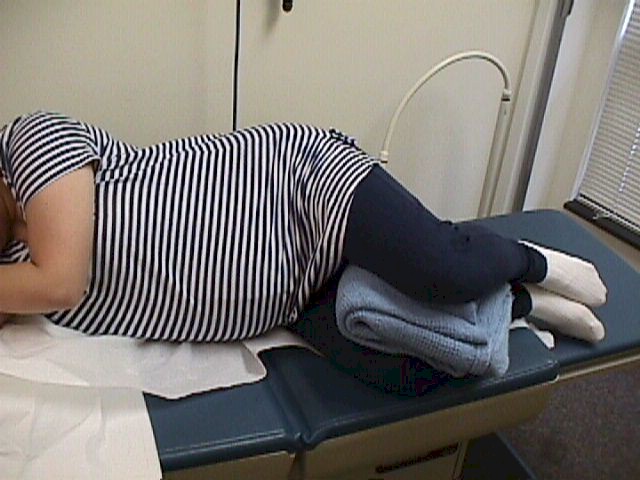
- When sleeping, assume a semi-fetal position, with both knees drawn up and a pillow placed between the knees.
- When sitting, make sure the knees are slightly flexed so that the knees are at least level with the hips or slightly higher than the hips.
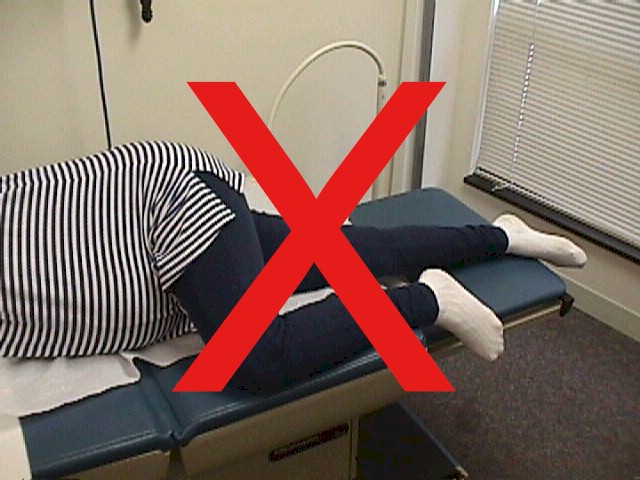
- Sleeping with one leg straight and the other knee drawn up is a bad position as far as the back is concerned. Torsion is placed on the lower spine, aggravating any pressure on the sciatic nerve that may be present.
- Sleeping on the side while pregnant is a good, idea, but both knees should be drawn up (flexing the thighs). Either side will work well.
- In order to maintain this semi-fetal position comfortably, it is necessary to place a small pillow, folded blanket or towel between the patient's knees. This will absorb moisture, separate the legs, minimizing skin-to-skin contact, and provide additional support to the legs. With practice, this position will become very comfortable.
 |
 |
 |
 |
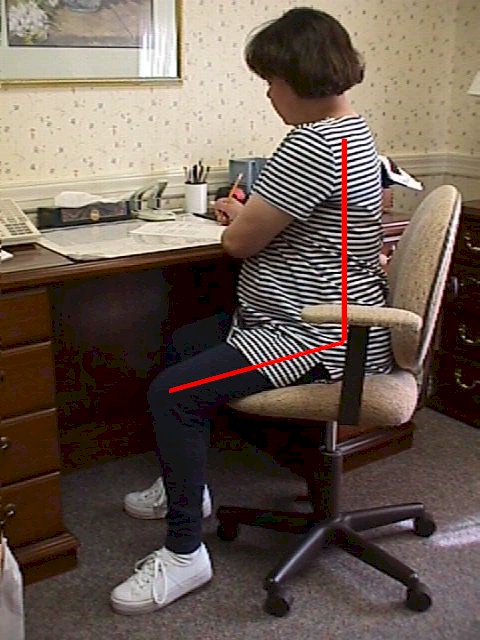
When sitting at a desk, posture is very important.
This picture illustrates two problems:
- The chair is too high, resulting in her knees being lower than her hips.
- She is not sitting straight toward the desk. This position places torsion on the lower back, aggravating her sciatica problem.
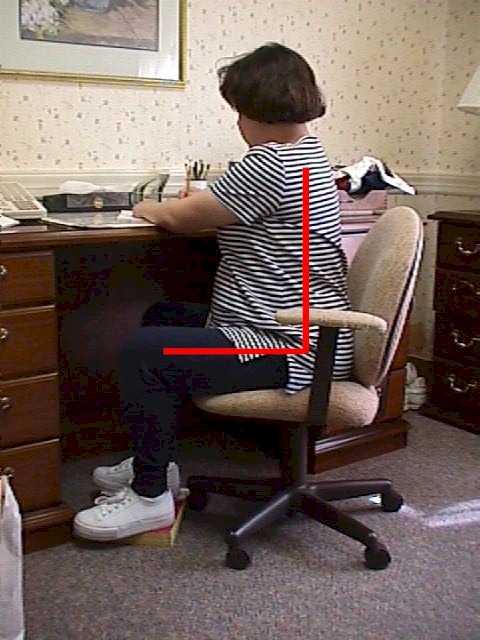
The lower picture has corrected one of the two problems.
- She has lowered her chair and put a Chicago phone book underneath her feet, elevating them. This results in her knees being level with her hips, rocking her pelvis backwards and straightening out the lower spine. This will ease pressure on the sciatic nerve.
- She has not turned to face the desk squarely. That would have solved the second problem.
Home · Introduction · Medical Support of Women in Field Environments · The Prisoner of War Experience · Routine Care · Pap Smears · Human Papilloma Virus · Contraception · Birth Control Pills · Vulvar Disease · Vaginal Discharge · Abnormal Bleeding · Menstrual Problems · Abdominal Pain · Urination Problems · Menopause · Breast Problems · Sexual Assault · Normal Pregnancy · Abnormal Pregnancy · Normal Labor and Delivery · Problems During Labor and Delivery · Care of the Newborn
|
Bureau of Medicine
and Surgery |
Operational
Obstetrics & Gynecology - 2nd Edition |
This web version of Operational Obstetrics & Gynecology is provided by The Brookside Associates Medical Education Division. It contains original contents from the official US Navy NAVMEDPUB 6300-2C, but has been reformatted for web access and includes advertising and links that were not present in the original version. This web version has not been approved by the Department of the Navy or the Department of Defense. The presence of any advertising on these pages does not constitute an endorsement of that product or service by either the Department of Defense or the Brookside Associates. The Brookside Associates is a private organization, not affiliated with the United States Department of Defense. All material in this version is unclassified.
This formatting © 2006
Medical Education Division,
Brookside Associates, Ltd.
All rights reserved