|
|
|

Operational Obstetrics & Gynecology
Normal Pregnancy
The estimated delivery date is calculated by adding 280 days to the first day of the last menstrual period. An alternative method of determining the due date is to add 7 days to the LMP, subtract three months, and add one year. These calculations are made easier with the use of a Gestational Age Calculator.
 One way to approximate a pregnancy's current gestational age is to use a tape measure to determine the distance from the pubic bone up over
the top of the uterus to the very top. That distance, measured in centimeters, is
approximately equal to the weeks of gestation, from about mid-pregnancy until nearly the
end of pregnancy. This is known as MacDonald's Rule.
One way to approximate a pregnancy's current gestational age is to use a tape measure to determine the distance from the pubic bone up over
the top of the uterus to the very top. That distance, measured in centimeters, is
approximately equal to the weeks of gestation, from about mid-pregnancy until nearly the
end of pregnancy. This is known as MacDonald's Rule.
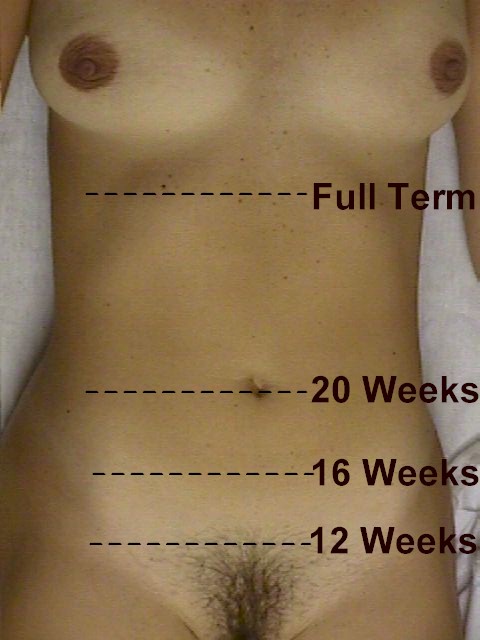
If a tape measure is unavailable, these rough guidelines can be used:
-
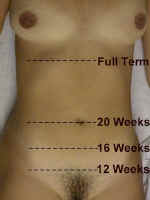 At 12 weeks, the uterus is just barely palpable above the pubic bone, using only an
abdominal hand.
At 12 weeks, the uterus is just barely palpable above the pubic bone, using only an
abdominal hand. - At 16 weeks, the top of the uterus is 1/2 way between the pubic bone and the umbilicus.
- At 20-22 weeks, the top of the uterus is right at the umbilicus.
- At full term, the top of the uterus is at the level of the ribs. (xyphoid process).
Ultrasound can be used to determine gestational age. Measurement of a crown-rump length during the first trimester (1-13 weeks) will give a gestational age that is usually accurate to within 3 days of the actual due date. During the second trimester (14-28 weeks), measurement of the biparietal diameter will accurately predict the due date within 10-14 days in most cases. In the third trimester, the accuracy of ultrasound in predicting the due date is less, with a plus or minus confidence range of as much as 3 weeks. A chart showing different ultrasound measurements at different gestational ages in shown in the Ultrasound Gestational Age Measurements chart.
Home · Introduction · Medical Support of Women in Field Environments · The Prisoner of War Experience · Routine Care · Pap Smears · Human Papilloma Virus · Contraception · Birth Control Pills · Vulvar Disease · Vaginal Discharge · Abnormal Bleeding · Menstrual Problems · Abdominal Pain · Urination Problems · Menopause · Breast Problems · Sexual Assault · Normal Pregnancy · Abnormal Pregnancy · Normal Labor and Delivery · Problems During Labor and Delivery · Care of the Newborn
|
Bureau of Medicine
and Surgery |
Operational
Obstetrics & Gynecology - 2nd Edition |
This web version of Operational Obstetrics & Gynecology is provided by The Brookside Associates Medical Education Division. It contains original contents from the official US Navy NAVMEDPUB 6300-2C, but has been reformatted for web access and includes advertising and links that were not present in the original version. This web version has not been approved by the Department of the Navy or the Department of Defense. The presence of any advertising on these pages does not constitute an endorsement of that product or service by either the Department of Defense or the Brookside Associates. The Brookside Associates is a private organization, not affiliated with the United States Department of Defense. All material in this version is unclassified.
This formatting © 2006
Medical Education Division,
Brookside Associates, Ltd.
All rights reserved